
From rankings to recommendations: Why SEO needs to evolve for the age of AI search
At a glance
- AI is changing search from rankings to recommendations. People increasingly ask AI systems for answers rather than choosing from a list of links.
- Traditional SEO still matters, but ranking highly may no longer be enough on its own.
- Context and authority are increasingly important. AI systems need to understand who you are, what you do and why your information should be trusted.
- Content should answer real questions clearly, using the language and terminology your audiences use.
- Structure matters. Semantic HTML, structured data and accessible content help automated systems interpret your website.
- Think beyond keywords. AI search is increasingly about meaning, relevance and relationships between information.
SEO isn’t disappearing. It’s evolving from simply competing for rankings towards making your organisation understandable and recommendable by AI systems.
For more than 20 years, search engine optimisation (SEO) has been the cornerstone of online visibility. The objective has been clear: create high-quality content, optimise it well, earn authority, and rank as highly as possible within Google’s search results.
That objective has not disappeared, but the way people search has changed.
Increasingly, people ask questions directly to AI assistants such as ChatGPT, Google Gemini, Microsoft Copilot, and Perplexity. Rather than being presented with a page of links, they are often given a single, conversational answer containing a handful of recommended organisations. This is one of the most significant changes to online visibility since search engines first emerged, and it means organisations now need to think not only about ranking well, but also about becoming one of the organisations that AI systems choose to recommend.
If you are new to AI-powered search, our introductory article, Is your website ready for AI search?, is a useful starting point.
How search behaviour has changed
Traditional search has generally followed a familiar pattern:
User → Google → List of search results → User chooses a website
AI-assisted search increasingly follows a different journey:
User → AI assistant → One consolidated answer → User visits one or two recommended sources
The example below shows how differently the same query is handled. A traditional Google search for ‘pet insurance with diabetes’ returns a list of ranked and sponsored websites for the user to work through. An AI assistant, given the same query, instead returns a single structured answer covering coverage options, what counts as a pre-existing condition, and what to do depending on when the diagnosis occurred.
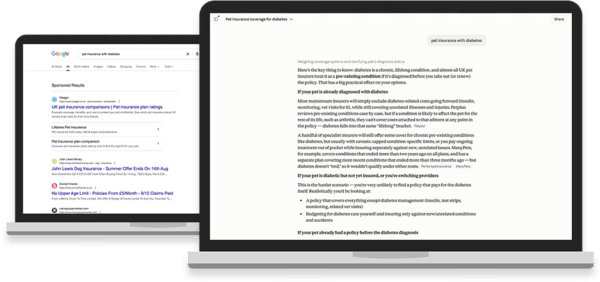
This difference becomes clear when you compare how people phrase their searches. For many years, the average Google search contained only a handful of words, typically short keyword phrases such as ‘pet insurance quotes’ or ‘caravan insurance UK’. Prompts entered into AI assistants tend to be considerably longer. Instead of searching for ‘pet insurance with diabetes’, a user might now ask, ‘My cat has diabetes and I need insurance that will not exclude ongoing treatment. What options are available?’
This is a fundamental shift in user behaviour. Content designed purely around short keyword phrases no longer reflects the way many people naturally ask questions, and organisations need to think about answering those fuller, more conversational questions directly.
SEO still matters, but it is no longer the whole story
A common misconception is that AI search replaces SEO. It does not. Traditional SEO remains one of the strongest foundations for AI visibility, and many of the signals that have influenced Google’s rankings for years continue to matter, including:
- technically well-built websites
- fast loading pages
- helpful, original content
- logical site structure and internal linking
- mobile usability and accessibility
- a clear page hierarchy
Organisations that have invested consistently in these areas are already well positioned.
The distinction is that AI systems appear to look beyond traditional ranking signals. Rather than asking which page ranks highest, they increasingly ask which organisation demonstrates the greatest expertise and authority. SEO helps an organisation become discoverable. Authority helps it become recommendable.
Structured data still matters, but mainly for Google. Schema markup continues to play an important role in helping Google understand website content. It supports rich search results, helps Google interpret pages more accurately, and appears to contribute positively to visibility within Google’s own AI features, including AI Overviews.
The evidence is less clear for other AI platforms. Several independent studies published during 2026 suggest that systems such as ChatGPT and Perplexity rely far more heavily on the visible content of a webpage than its structured data, tending to treat schema markup as ordinary text rather than as a distinct, machine-readable signal. Gemini appears to be a partial exception, having demonstrated the ability to read structured data correctly during a live page fetch in independent testing.
This does not mean schema has become unimportant. Structured data remains a recognised SEO best practice and continues to provide measurable benefits within Google’s ecosystem. Organisations should therefore continue implementing appropriate schema, while recognising that it represents one component of a much broader AI search strategy rather than a universal solution.
We cover structured data, schema implementation, and Google’s Rich Results Test in more detail in Preparing websites for AI search.
What builds authority with AI systems
Although AI models remain largely opaque, a growing body of evidence suggests they rely heavily on signals that indicate credibility and expertise, including:
- recognised subject expertise and authoritative content
- strong review profiles
- consistent information across the web
- mentions by trusted third parties and citations from respected publications
- evidence that others discuss and recommend the organisation
- accurate, up-to-date information
None of these ideas are new. Historically, they supported SEO. Increasingly, they appear to support AI recommendations directly, which makes them strategic assets rather than simply marketing activities.
Reviews have long influenced purchasing decisions, and they increasingly appear to influence how AI systems assess organisations too. Unlike traditional search engines, which have historically relied heavily on links and page-level signals, AI assistants attempt to evaluate an organisation’s overall reputation. Reviews provide valuable third-party evidence that real customers have had positive experiences, particularly when those reviews describe specific services, expertise, or outcomes rather than offering only general praise. Organisations should therefore:
- encourage satisfied clients to leave thoughtful, detailed reviews on platforms such as Google, Trustpilot, Feefo, or Reviews.co.uk where appropriate
- respond to reviews to demonstrate engagement and provide additional context
Research into AI search is still developing rapidly and the precise weighting given to reviews varies between platforms, but reviews are consistently identified as one of the trust signals that help AI systems distinguish authoritative organisations from their competitors.
Brand mentions matter for the same reason. Traditional SEO placed enormous emphasis on backlinks, and backlinks remain valuable, but AI systems also appear to recognise a much broader range of authority signals, including:
- mentions in industry publications
- interviews and podcasts
- conference presentations
- local and national media coverage
- professional associations
- expert commentary
- citations by trusted organisations
The underlying principle is straightforward: the more often an organisation is discussed by credible third parties, the easier it becomes for AI systems to understand that it is recognised within its field. This reflects how people naturally establish trust. If multiple independent sources consistently refer to an organisation as knowledgeable and authoritative, both people and AI systems are more likely to regard it as a reliable source of information.
Authority is earned, not optimised. Many of the strongest signals influencing AI recommendations are created away from an organisation’s own website, through reviews, industry recognition, expert commentary, and independent mentions.
Google’s concept of E-E-A-T (experience, expertise, authoritativeness, and trustworthiness) closely aligns with the qualities AI systems appear to value when selecting sources. Organisations can strengthen these signals by:
- publishing genuinely helpful, expert-written content
- identifying authors where appropriate
- demonstrating relevant qualifications and experience
- keeping important information accurate and up to date
- citing reliable sources
- maintaining a consistent and trustworthy presence online
None of these practices exist solely for AI. They represent good communication and good governance more generally.
A practical example
Imagine someone asks ChatGPT, ‘Who are the best insurers for pets with pre-existing conditions in the UK?’ A traditional search engine would primarily return a ranked list of websites. An AI assistant attempts something different: it tries to identify organisations that appear knowledgeable, trustworthy, and relevant before generating a recommendation.
An insurer that publishes comprehensive guidance, answers detailed customer questions, demonstrates genuine expertise, and has built a strong reputation across the wider web is likely to be in a stronger position than one whose strategy relies primarily on keyword optimisation. The objective is no longer simply to achieve a high ranking. It is to become one of the organisations that AI systems regard as an authoritative source.
What this means in practice
Organisations do not need to abandon traditional SEO in favour of an entirely new strategy. Instead, they should broaden their thinking. Alongside established SEO best practice, organisations should increasingly focus on:
- answering the questions customers genuinely ask
- publishing content that demonstrates real expertise
- building a strong review profile
- earning mentions from trusted third parties
- maintaining accurate information across the web
- implementing structured data where appropriate
- reviewing and updating cornerstone content regularly
- strengthening internal links between related topics
- ensuring technical quality remains high
For many organisations, particularly charities, universities, membership organisations, research institutions, and specialist businesses, these are not entirely new priorities. They are the characteristics of a well-managed website supported by a respected organisation. AI search simply reinforces their importance.
Looking ahead
The way people search for information will continue to evolve. Traditional search engines remain enormously important and are unlikely to disappear any time soon, but AI assistants are rapidly becoming another important way in which people discover organisations, products, and services.
The organisations most likely to benefit are unlikely to be those chasing every new acronym or short-term optimisation technique. They will be those that consistently invest in genuine expertise, authoritative content, trusted relationships, and technically well-managed websites. Good SEO remains essential, but increasingly, the objective extends beyond achieving a high ranking. It is to become one of the organisations that people trust and AI systems choose to recommend.



 '
'

 '
'