
GEO, AEO, LLMO: Making sense of AI search’s alphabet soup
SEO was complicated enough.
Now we’re told we also need to think about GEO, AEO, LLMO, AIO and a growing list of other acronyms. If you’ve spent any time reading about digital marketing over the past year, you’ve probably come across at least some of them.
Has search really become this complicated, or are we simply giving different names to the same underlying ideas?
The good news is that, for most organisations, you don’t need to become fluent in every new acronym. The principles behind them are remarkably consistent. This article explains what the various terms mean, where the genuine differences lie, and why it’s often more important to focus on the fundamentals than the terminology.
What has actually changed in search?
For around 25 years, search engine optimisation (SEO) had one primary goal: helping websites appear prominently within Google’s search results. Users entered a query, Google returned a list of links, and people clicked through to the pages that looked most relevant.
AI-powered search has introduced a different model.
Platforms such as ChatGPT, Google’s AI Overviews, Perplexity and Microsoft Copilot increasingly synthesise information from multiple sources before presenting a single, conversational answer. Rather than directing users to a list of websites, they often answer the question themselves.
The practical consequence is significant. A website can perform well in traditional search yet receive little or no visibility within AI-generated answers. Although AI systems still draw heavily on information that performs well in conventional search, the relationship is no longer one-to-one.
If you’re new to this subject, you may also find our article “Is your website ready for AI search?” a useful introduction. It explains why AI-assisted search represents one of the biggest changes to online visibility since search engines first emerged.
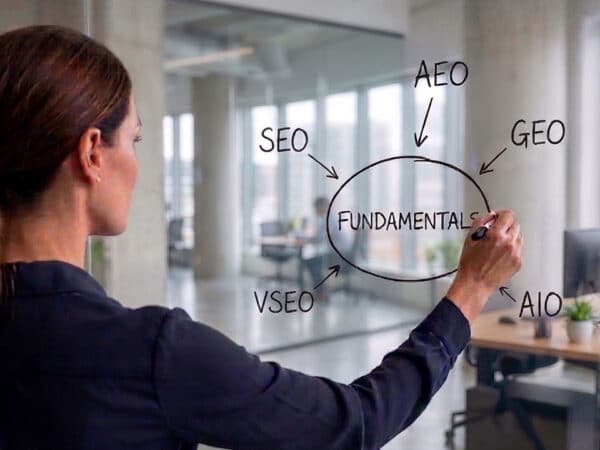
The acronyms explained
SEO – Search Engine Optimisation
SEO is the established practice of improving a website’s visibility in search engines such as Google.
Despite all the discussion around AI, SEO remains the foundation of online visibility. Nothing about AI search makes traditional SEO obsolete. In fact, many of the same signals that have always mattered, including authoritative content, technical quality, user experience and credibility, continue to influence AI systems.
AEO – Answer Engine Optimisation
AEO focuses on structuring content so that AI systems can extract and present it as a direct answer.
The idea is straightforward. Instead of encouraging users to click through multiple search results, answer engines attempt to provide the answer immediately.
For this reason, AEO places particular emphasis on clear questions, concise answers, logical page structure and content that can easily be understood outside its original context.
GEO – Generative Engine Optimisation
Generative Engine Optimisation, or GEO, has emerged as perhaps the broadest term for optimising content for AI-powered search.
The objective is to increase the likelihood that platforms such as ChatGPT, Google AI Overviews, Google Gemini and Perplexity will cite, recommend or reference your organisation when generating answers.
In practice, GEO and AEO describe almost exactly the same activities. GEO has gradually become the preferred label because it reflects the wider range of generative AI platforms rather than focusing solely on answering questions.
LLMO – Large Language Model Optimisation
LLMO shifts the emphasis slightly towards the large language models that underpin many AI systems.
Rather than concentrating on search interfaces, discussions around LLMO often focus on how language models learn about organisations, recognise trusted sources and form recommendations.
For most organisations, however, LLMO overlaps almost entirely with GEO. The distinction is primarily one of emphasis rather than day-to-day practice.
SGE – Search Generative Experience
SGE was Google’s original name for its AI-powered search experience during the testing phase between 2023 and 2024.
Google has since replaced the term with AI Overviews, although you’ll still encounter SGE in older articles and technical documentation.
AIO – AI Overview Optimisation
AIO refers specifically to improving visibility within Google’s AI Overviews.
Unlike GEO, which covers multiple AI-powered platforms, AIO focuses solely on Google’s implementation. It’s useful terminology when discussing Google specifically, but it represents only one part of the wider AI search landscape.
VSEO – Voice Search Optimisation
Voice Search Optimisation predates the current wave of generative AI by several years.
Many of its underlying principles remain highly relevant today. Conversational language, question-based content and concise answers all support both voice assistants and modern AI-powered search.
Do the distinctions actually matter?
For most organisations, not particularly.
The optimisation techniques behind GEO, AEO and LLMO overlap to such an extent that the vast majority of practical work is identical regardless of which acronym you prefer.
From our own work reviewing and improving websites for AI-assisted search, we’ve found that organisations rarely benefit from debating terminology. They benefit from investing in well-structured content, technically robust websites and genuine subject expertise.
The danger isn’t choosing the “wrong” acronym.
The danger is allowing discussions about terminology to distract from the work that actually improves visibility.
Whether you describe your approach as GEO, AEO or LLMO, the underlying objective remains the same: producing information that AI systems recognise as trustworthy, useful and worth citing.
Many of the optimisation techniques now being discussed are refinements of practices that have always mattered. Clear information architecture. Helpful content. Technical excellence. Demonstrable expertise. Organisations that have invested in these fundamentals are already better positioned than those chasing the latest terminology.
How large is the AI search shift?
The shift is real and growing, but it’s important to keep it in perspective.
Traditional search remains enormously important. Google continues to process billions of searches every day, and many people still rely heavily on conventional search engines when looking for information online.
At the same time, AI-assisted search is becoming an increasingly important additional layer rather than a replacement.
People are beginning to ask questions directly to ChatGPT, Microsoft Copilot, Google AI Overviews and Perplexity. Often, they receive sufficiently complete answers without ever visiting a website.
For organisations whose websites play an important role in attracting customers, supporting members or communicating research, this represents a significant change in how people discover information.
The direction of travel is becoming increasingly clear.
Organisations no longer need to optimise solely for search engines.
Increasingly, they also need to optimise for AI systems that interpret, summarise and recommend information.
What this means in practice
The encouraging news is that strong SEO and strong GEO are not competing priorities.
Both depend on remarkably similar foundations.
Organisations should focus on:
- publishing genuinely useful content that answers real questions
- demonstrating genuine expertise and authority
- maintaining a technically robust website
- structuring information logically with clear headings
- using appropriate structured data and schema where relevant
- strengthening internal linking between related content
- keeping important information accurate and up to date
- reviewing cornerstone content regularly as knowledge and guidance evolve
Answer-first content has become particularly important. AI systems often extract individual sections rather than entire pages, making it essential that each section provides meaningful information in its own right.
Similarly, content freshness matters more than ever. Reviewing and updating key pages helps demonstrate that information remains current and reliable.
For organisations managing complex websites, such as charities, universities, membership organisations and research institutions, these have always been signs of a well-managed website.
AI search simply reinforces their importance.
A note on terminology going forward
The language surrounding AI search will continue to evolve.
Some of today’s terms will disappear. Others will emerge.
Rather than worrying about which acronym becomes dominant, organisations are usually better served by focusing on the principles behind them: creating genuinely useful information that is easy for both people and AI systems to understand.
If you need a single piece of shorthand, GEO is currently emerging as the broadest and most widely recognised term for optimising content for AI-powered search.
Whatever terminology eventually wins, organisations that focus on producing useful, authoritative and well-structured content are unlikely to regret that investment.
Search technology will continue to evolve.
The principles of good communication are far more enduring.


 '
'

 '
'