
Preparing websites for AI search: a practical guide for modern organisations
Executive Summary
Artificial intelligence is changing how people discover organisations online. Increasingly, AI-powered search tools summarise information and recommend organisations directly, often before users visit a website. This guide explains how AI search works, why it matters, and the practical steps organisations can take to ensure their websites remain visible, understandable and effective. The recommendations apply equally to charities, public sector organisations, universities, museums, membership bodies and commercial businesses, and focus on long-term best practice rather than short-lived trends.
Part 1 – Understanding AI search
- Introduction
- Why AI search matters
- How AI systems obtain information
- Reviewing access for AI crawlers
- Check your robots.txt file
- AI readiness begins with good governance
Part 2 – Improving your website
- Structured data: helping machines understand your website
- What schema should most organisations use?
- Good schema reflects your organisation accurately
- Testing your existing implementation
- Content remains your greatest asset
- Write for people first
- Keep information current
- Consistency matters beyond your own website
- WordPress makes many improvements straightforward
- Performance still matters
- A practical AI readiness checklist
Part 3 – Putting it into practice
- Preparing for the future
- What does a professional AI readiness review include?
- Common issues we encounter
- AI readiness is not a one-off project
- Practical improvements usually deliver wider benefits
- How Castlegate IT can help
- Final thoughts
- Further reading
Part 1 – Understanding AI search
Introduction
For more than twenty years, search engine optimisation has largely meant one thing: helping search engines rank your website more highly than your competitors.
That is still important, but it is no longer the whole picture.
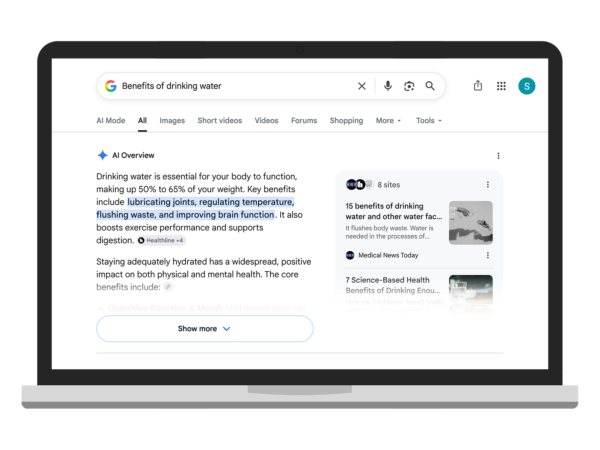
Increasingly, people are asking questions directly to AI-powered services such as ChatGPT, Perplexity and Google’s AI Overviews rather than browsing through pages of search results. Instead of presenting ten blue links, these systems analyse information from multiple sources and generate a single answer.
For organisations that rely on their websites to generate enquiries, recruit staff, provide information or support customers, this represents an important shift.
A prospective client may now form an opinion about your organisation before they ever visit your website.
If your website is difficult for AI systems to understand, there is a greater risk that your organisation will simply not appear in the answers they generate.
The encouraging news is that preparing your website for AI search does not require an entirely new optimisation strategy. The same principles that have always underpinned good websites remain important: clear content, sound technical implementation, accessibility, structured information and ongoing maintenance.
AI has not replaced SEO.
It has increased the value of doing the fundamentals well.
Why AI search matters
Traditional search engines presented users with a ranked list of websites.
AI search works differently.
When someone asks:
“Who are the best WordPress developers in Yorkshire?”
or
“Which web agencies specialise in websites for museums?”
an AI system may compare multiple organisations, summarise their services and recommend a small number of suppliers without requiring the user to visit dozens of websites.
The websites that contribute to those answers are not selected solely because they rank highly.
They are selected because the AI system has confidence that it understands them.
That confidence comes from several factors working together:
- clear, well-written content
- logical page structure
- accurate structured data
- accessible HTML
- strong technical SEO
- fast page loading
- trustworthy information presented consistently across the web
None of these ideas are new.
What has changed is the importance of getting them right.
AI systems are designed to answer questions rather than simply index pages. The organisations that explain themselves clearly are therefore becoming easier for those systems to recommend.
For many organisations, improving AI search visibility is not about chasing a new technology. It is about ensuring that years of investment in a website continue to deliver value as search behaviour evolves.
Search engines and AI systems both benefit from websites that are:
- technically robust
- well maintained
- clearly structured
- accessible
- fast
- easy to understand
The same improvements that make a website easier for Google to index also make it easier for AI systems to interpret.
That is good news.
Rather than investing in entirely new technologies, many organisations will achieve significant improvements simply by reviewing their existing websites against current best practice.
How AI systems obtain information
Although people often refer to “AI search” as though it were one thing, different AI platforms obtain information in different ways.
Some rely heavily on conventional search indexes.
Others perform live crawling of websites.
Some use dedicated crawlers to collect publicly available information for future AI development, while others combine multiple approaches.
For example:
- Google’s AI Overviews are closely integrated with Google’s existing search infrastructure.
- Perplexity performs extensive live retrieval of information when answering questions.
- ChatGPT may combine information from its underlying models with live web search depending on how it is being used.
The practical consequence is straightforward.
Your website needs to remain accessible, understandable and technically well maintained regardless of which AI platform your audience chooses.
There is no single optimisation that works for every AI service.
Instead, organisations should focus on producing websites that communicate clearly with both people and machines.
Reviewing access for AI crawlers
One of the simplest technical checks is also one of the most frequently overlooked.
Many websites use security plugins, Web Application Firewalls (WAFs) or bot protection services to reduce malicious traffic.
These products are extremely valuable, but they occasionally block legitimate crawlers unintentionally.
Different AI providers operate different crawlers.
Examples include:
- GPTBot (OpenAI)
- ClaudeBot (Anthropic)
- Google-Extended
- PerplexityBot
Whether these crawlers should be allowed depends entirely on your organisation’s own policy.
Some organisations are comfortable allowing AI systems to access publicly available content.
Others deliberately restrict certain crawlers because of governance, intellectual property or commercial considerations.
Both positions are entirely reasonable.
The important point is that the decision should be deliberate.
We regularly encounter websites where crawler access has been restricted accidentally by default security settings rather than conscious policy.
Check your robots.txt file
Your robots.txt file tells automated crawlers which areas of a website they may access.
It is usually available at:
yourdomain.co.uk/robots.txt
Look for entries relating to AI crawlers.
For example:
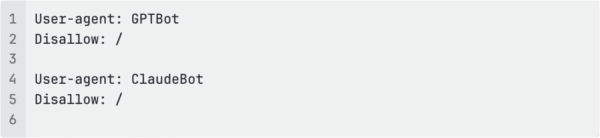
Finding entries such as these does not necessarily indicate a problem.
However, it is worth confirming that they reflect an intentional organisational decision rather than a historic configuration that nobody has reviewed.
If your website also uses security products such as Wordfence, iThemes Security or Cloudflare firewall rules, review those configurations as well to ensure legitimate crawlers have not been blocked inadvertently.
AI readiness begins with good governance
Preparing a website for AI search is not simply a technical exercise.
It also requires organisations to understand what information they are making publicly available, who is permitted to access it and how accurately that information represents the organisation.
Technical configuration, content quality and governance increasingly overlap.
Regular maintenance, accurate information, consistent technical standards and ongoing review all contribute towards making a website easier for AI systems to understand and trust.
In the next section, we will look at one of the most powerful tools available for helping machines understand a website: structured data and Schema markup.
Part 2 – Improving your website
Structured data: helping machines understand your website
One of the most valuable improvements many organisations can make is implementing high-quality structured data.
Structured data, often referred to as Schema markup, is information embedded within a webpage that explicitly describes what that page contains. Rather than asking Google or an AI platform to infer that your organisation provides engineering consultancy in Yorkshire, or that a particular page describes one of your services, structured data tells it directly.
This reduces ambiguity and helps search engines and AI systems understand your website with greater confidence.
Think of it as adding labels to information that already exists. Human visitors may already understand that a page describes one of your services, but machines appreciate having that information presented in a consistent, standardised format.
Good structured data will not compensate for poor content, but it does make good content significantly easier to interpret.
What schema should most organisations use?
There are hundreds of schema types, but most organisations only require a relatively small number.
For a typical business website, the most valuable are:
- Organisation or LocalBusiness to describe the organisation itself.
- ProfessionalService (where appropriate) to describe the nature of the business.
- Service for individual service pages.
- Article or BlogPosting for editorial content.
- FAQPage where genuine question-and-answer content exists.
- BreadcrumbList to describe the site’s navigation structure.
These provide search engines with reliable information about who you are, what you do and how your website is organised.
Many websites already generate some schema automatically through SEO plugins, but automatic does not necessarily mean complete or accurate.
It is common to find websites that technically contain schema while omitting important services, locations or organisational information.
Good schema reflects your organisation accurately
One of the misconceptions surrounding schema is that more is always better.
It is not.
Adding inaccurate or misleading structured data is far worse than having less of it.
The objective is to describe your organisation truthfully and consistently.
This matters most when the same information appears elsewhere, a point covered in full below.
Structured data is most effective when it reinforces information that already appears elsewhere on your website.
Consistency builds confidence.
Testing your existing implementation
Fortunately, you do not need specialist software to determine whether structured data already exists on your website.
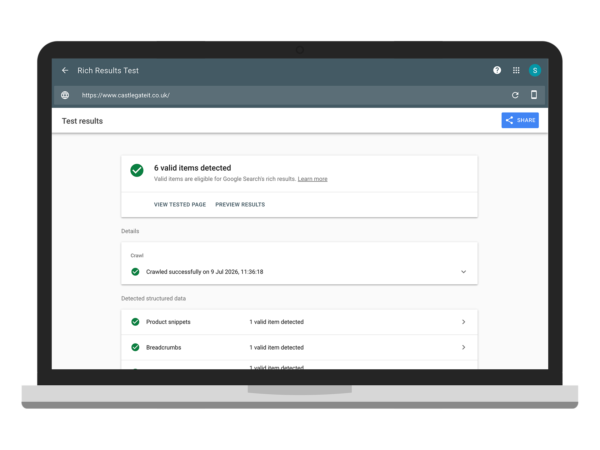
Google provides a free Rich Results Test that analyses individual pages and identifies recognised structured data.
The tool will indicate:
- whether schema has been detected
- whether the markup is valid
- any warnings or errors
- which rich result types may be available
Passing the test does not necessarily mean your implementation is complete, but it provides an excellent starting point.
Where organisations have more complex requirements, additional validation tools can be used to assess the quality and completeness of the implementation.
Content remains your greatest asset
If structured data tells AI systems what a page represents, the content itself tells them whether it is worth using.
No amount of technical optimisation can compensate for vague, outdated or poorly organised content.
The organisations most likely to appear in AI-generated answers tend to explain themselves clearly.
Visitors and AI systems alike should be able to answer four simple questions within a few seconds:
- What does this organisation do?
- Who does it help?
- Where does it operate?
- Why should someone choose it?
Many websites answer these questions surprisingly poorly.
Marketing language often replaces useful information.
Pages describe solutions without explaining the problems they solve.
Service pages assume knowledge that prospective customers do not yet have.
AI systems struggle with exactly the same ambiguities as human visitors.
The clearer your website is, the easier it becomes for both to understand.
Write for people first
There is understandable concern that websites may become “optimised for AI” rather than written for human readers.
In practice, the opposite is true.
The websites most likely to perform well are usually those that communicate naturally.
- Write in plain English.
- Use descriptive headings.
- Avoid unnecessary jargon.
- Answer the questions your audience is actually asking.
- Where technical terminology is necessary, explain it.
An experienced engineer, an IT manager and a procurement officer may all visit the same page. Good content allows each of them to understand the information without oversimplifying it.
This has always been good communication.
AI systems simply reward it more consistently than traditional search engines.
Keep information current
AI systems increasingly value current, trustworthy information.
Review key pages regularly.
Check that:
- Staff information is current.
- Contact details remain accurate.
- Services reflect what you currently offer.
- Outdated news and announcements have been removed or archived.
- Pricing information remains correct where published.
Small inaccuracies accumulate over time.
Maintaining a website is often less about making dramatic changes than preventing gradual decline.
Consistency matters beyond your own website
Search engines and AI platforms compare information from multiple sources.
If your website lists one telephone number while your Google Business Profile lists another, confidence decreases.
The same applies to addresses, organisation names, opening hours and other key information.
Review consistency across:
- your website
- Google Business Profile
- Companies House
- industry directories
- membership organisations
- social media profiles where appropriate
This is sometimes referred to as maintaining a consistent digital identity.
For AI systems, consistency is an important indicator of trustworthiness.
WordPress makes many improvements straightforward
If your website runs on WordPress, implementing many of these improvements is relatively straightforward.
Several mature plugins provide excellent support for structured data.
For many organisations:
- Yoast SEO provides a strong foundation and automatically generates core schema.
- Schema Pro offers considerably greater flexibility where organisations have multiple services, departments or locations.
- Rank Math provides comprehensive schema support and includes many features within its free edition.
The best choice depends on your existing website rather than any single plugin being universally superior.
In many cases, improving an existing implementation is preferable to replacing it.
Performance still matters
Page speed remains an important ranking factor and an important usability factor.
Although AI systems may be more tolerant of slower pages than traditional web crawlers, fast websites are still easier to process, easier to revisit and generally provide a better experience for visitors.
Performance improvements rarely benefit only one aspect of a website.
Faster websites typically deliver:
- improved user experience
- better accessibility
- stronger search performance
- lower bounce rates
- greater confidence in the technical quality of the website
Google’s Core Web Vitals remain one of the most useful indicators of overall website health and should be monitored regularly.
A practical AI readiness checklist
Before commissioning a detailed technical review, there are several straightforward checks most organisations can perform themselves.
Technical checks
- Review your robots.txt file for unexpected restrictions affecting legitimate AI crawlers.
- Review firewall and security plugin settings.
- Test representative pages using Google’s Rich Results Test.
- Check Google Search Console for Core Web Vitals issues.
- Confirm that pages remain indexable.
Content checks
- Does every major service have its own page?
- Does each page clearly explain who or what it is intended for?
- Are headings descriptive rather than promotional?
- Are contact details current?
- Does the content explain your organisation clearly to someone unfamiliar with it?
Governance checks
- Is organisational information consistent wherever it appears online?
- Is website content reviewed regularly to ensure it remains accurate?
- Is responsibility for keeping the website up to date clearly assigned?
- Is structured data reviewed whenever significant changes are made to the website?
None of these checks requires major redevelopment.
Collectively, however, they provide an excellent indication of how well prepared a website is for the growing importance of AI-powered search.
Part 3 looks at how to prioritise improvements and what a professional review involves.
Part 3 – Putting it into practice
Preparing for the future
Artificial intelligence is changing rapidly, and there is no shortage of articles claiming to reveal the latest optimisation technique or the newest ranking factor.
History suggests a more measured approach is usually the right one.
Search technology has evolved continuously for more than two decades. Mobile-first indexing, HTTPS, responsive design, Core Web Vitals and accessibility all became important because they improved the quality of the web, not because they were temporary trends.
We believe AI search will follow the same pattern.
What does a professional AI readiness review include?
Many organisations already have the foundations in place. The challenge is identifying where improvements will have the greatest impact.
A structured review should focus on practical recommendations rather than producing an overwhelming list of theoretical best practice.
At Castlegate IT, we would typically review the following areas.
Technical configuration
- robots.txt configuration
- XML sitemaps
- crawlability and indexing
- firewall and security rules affecting legitimate crawlers
- Core Web Vitals
- page performance
- mobile usability
- accessibility considerations
Structured data
- existing Schema implementation
- completeness and accuracy
- opportunities for additional schema
- validation of structured data
- consistency across the website
Content
- clarity of descriptions
- organisation of key information
- heading structure
- opportunities to answer common customer questions
- content that has become outdated or duplicated
Website governance
- ownership of website content
- maintenance processes
- consistency of organisational information
- alignment with Google Business Profile and other authoritative sources
The aim is to identify the improvements most likely to strengthen your website’s visibility, usability and long-term maintainability.
Common issues we encounter
Although every website is different, certain issues appear regularly.
These include:
- Structured data that is incomplete or inaccurate.
- Service pages that contain little meaningful information.
- Multiple pages competing for the same search terms.
- Outdated contact information.
- Inconsistent organisation details across different platforms.
- Security software unintentionally restricting legitimate crawlers.
- Technical SEO issues that have accumulated over several years.
None of these issues is unusual, and none is particularly difficult to resolve once identified.
The greatest risk is often that they remain unnoticed because the website appears to be functioning normally.
AI readiness is not a one-off project
One of the biggest misconceptions surrounding AI optimisation is that it can be completed once and forgotten.
In reality, AI readiness should become part of normal website maintenance.
- New services are introduced.
- Content changes.
- Staff members leave.
- Contact details evolve.
- Plugins are updated.
- Security policies change.
Each of these developments has the potential to affect how accurately your website represents your organisation.
Regular reviews help ensure that small issues are identified before they become significant ones.
For many organisations, an annual review is sufficient. Larger or more complex websites may benefit from more frequent assessment.
Practical improvements usually deliver wider benefits
One of the reassuring aspects of preparing for AI search is that the work rarely benefits AI alone. Better structured data improves conventional search results, better content helps visitors, faster pages and stronger accessibility improve the experience for everyone, and better governance reduces operational risk. Very little of this work exists solely for AI.
Instead, AI search reinforces many of the practices that have always characterised well-managed websites.
How Castlegate IT can help
We have been designing, developing and maintaining WordPress websites for more than twenty years.
During that time, search technology has evolved repeatedly, but one principle has remained constant: organisations benefit most from websites that are technically sound, well maintained and built around the needs of their users.
Our approach reflects that philosophy.
Rather than recommending fashionable technologies or unnecessary redevelopment, we begin by understanding your existing website and identifying the improvements most likely to deliver measurable value.
Our recommendations are always proportionate to the website, the organisation and its objectives.
Final thoughts
AI-powered search is not replacing conventional search overnight.
Google Search remains enormously important, and traditional SEO continues to play a central role in online visibility.
What is changing is the way people consume information.
Increasingly, AI systems are becoming the first point of contact between an organisation and a prospective customer.
That makes clarity, technical quality and trustworthy information more valuable than ever.
Fortunately, the organisations best placed to benefit are not necessarily those investing in entirely new technologies. They are the organisations that already maintain accurate information, produce useful content, follow technical best practice and review their websites regularly, principles that have always mattered.
Artificial intelligence simply gives us another reason to take them seriously.
If you would like an independent assessment of how well your website is prepared for AI-powered search, we would be pleased to help.
We are always happy to begin with an informal conversation and provide an honest assessment before discussing any wider engagement.
Further reading
The following resources provide authoritative guidance on many of the topics discussed in this article.
- Google Search Central: AI features and website guidance
- Google Search Central: Structured data documentation
- Google Rich Results Test
- Schema documentation
- OpenAI GPTBot documentation
- Anthropic ClaudeBot documentation
- Google Search Console Help: Core Web Vitals
- Google’s PageSpeed Insights
About Castlegate IT
Castlegate IT designs, develops and supports high-performance WordPress websites for organisations across the public sector, education, manufacturing, museums and heritage, charities and professional services. We combine technical expertise with long-term support to help organisations build secure, accessible and maintainable websites that continue to deliver value as technology evolves.


 '
'

 '
'