
Your staff are probably already using AI. Is your organisation ready?
At a glance
- Your staff are probably already using AI, whether or not your organisation has formally adopted it.
- AI can improve productivity, but it also creates risks around confidential information, accuracy, copyright and accountability.
- Blanket bans are rarely the answer. Staff need clear guidance on what tools they can use, what information they can share and when human checking is required.
- An AI use policy provides that framework, helping people use AI confidently and responsibly.
- Keep the policy practical and review it regularly. AI technology, regulation and working practices are changing quickly.
The question is no longer simply whether your organisation should use AI, but whether your people know how to use it safely and responsibly.
Generative AI tools such as ChatGPT, Claude, Microsoft Copilot and Midjourney have been adopted at an extraordinary pace. Unlike many new technologies, they haven’t arrived through centrally managed IT projects or formal procurement processes. Instead, they’ve appeared one employee, one browser tab and one subscription at a time.
The reality is that many organisations are already using generative AI every day, whether management realises it or not.
Staff are drafting emails, summarising reports, analysing spreadsheets, generating images, writing code and brainstorming ideas. Used appropriately, these tools can save time, improve productivity and help people focus on higher-value work.
Organisations are also beginning to understand how AI is changing the way people discover information online. If you haven’t already read it, our article Is your website ready for AI search? explains how AI-assisted search is changing website visibility and what organisations can do to prepare.
The question is no longer whether people should use AI. For many organisations, that decision has already been made.
The more important question is whether everyone understands where the boundaries are.
Does your organisation need an AI policy?
Without clear guidance, employees are left to make their own decisions about what information can safely be shared with AI tools, when AI-generated content is appropriate, and how that content should be reviewed before it’s used externally.
That creates uncertainty for staff and unnecessary risk for organisations.
A well-written AI use policy helps establish a consistent approach across the organisation. Rather than discouraging innovation, it enables people to use AI confidently, responsibly and in ways that support the organisation’s objectives.

What should an AI policy cover?
Every organisation is different, but a sensible policy should answer questions such as:
- Which AI tools are approved for use, and whether personal accounts or unofficial platforms are permitted.
- What information must never be entered into an AI system, including personal data, commercially sensitive information, client data, passwords and other confidential material.
- Which tasks are appropriate for AI assistance, and which always require human judgement and approval.
- Whether AI-generated content must be reviewed and edited before being shared with clients, customers or the public.
- When, if ever, AI use should be disclosed.
- How copyright, intellectual property and ownership of AI-generated material should be managed.
- How the policy supports existing obligations around data protection, confidentiality and contractual commitments.
- Who remains accountable for decisions made with the assistance of AI.
A good policy should be practical, proportionate and easy for staff to understand. It should provide confidence rather than create unnecessary barriers.
Why organisations are introducing AI policies
There are several reasons why organisations are choosing to formalise their approach.
Protecting confidential information
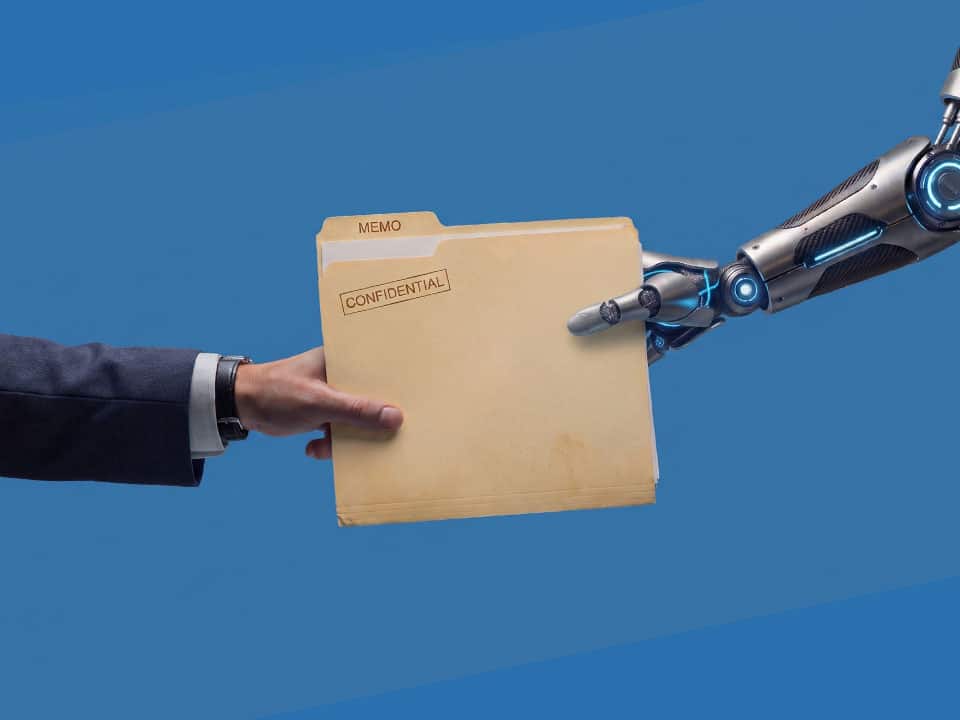
Without guidance, staff may unintentionally share confidential information, client data or commercially sensitive material with public AI services. A policy helps reduce this risk by establishing clear boundaries.
Maintaining quality
Generative AI can produce impressive results, but it can also make mistakes, misunderstand context or present inaccurate information with confidence. Requiring appropriate human review helps maintain quality and protects an organisation’s reputation.
Building client confidence
Increasingly, clients are asking suppliers how AI is used in the services they provide. Having a clear, considered policy demonstrates that AI is being used thoughtfully rather than informally or inconsistently.
Providing legal clarity
The legal landscape surrounding AI continues to evolve. A policy helps organisations establish sensible internal practices around intellectual property, copyright and responsible use while the wider regulatory environment develops.
Giving staff confidence
Perhaps most importantly, a policy removes uncertainty. Instead of wondering whether they’re allowed to use AI, employees understand where it adds value, where additional care is needed, and when human expertise remains essential.
AI policies should reflect your organisation
There is no such thing as a one-size-fits-all AI policy.
A charity handling sensitive beneficiary information will have different requirements from a manufacturing business, a university, a local authority or a digital agency. Your policy should reflect the information you handle, the services you provide, your contractual obligations and your organisation’s appetite for adopting new technology.
Simply downloading a generic policy from the internet may satisfy a tick-box exercise, but it rarely provides meaningful guidance for your staff.
Like many organisational policies, an AI use policy should be reviewed periodically as AI technology, legislation and working practices continue to evolve. It should become part of your organisation’s wider governance framework rather than a document that’s written once and forgotten.
How we can help
Over the past year we’ve been helping organisations understand the practical implications of generative AI, from preparing websites for AI-assisted search through to advising on the responsible use of AI within day-to-day operations.
We believe AI has enormous potential to improve productivity and support better decision-making, but only when it’s introduced thoughtfully and with appropriate safeguards.
Whether you are taking your first steps with AI or looking to formalise existing practices, we can help you develop an AI use policy that reflects the way your organisation works. We work with charities, educational institutions, public sector organisations and businesses to create practical policies that balance innovation with good governance, helping staff use AI confidently while protecting sensitive information, maintaining quality and meeting organisational responsibilities.
Our aim is not to discourage the use of AI. Quite the opposite. We want organisations to embrace its potential with confidence, clarity and appropriate governance.


 '
'

 '
'